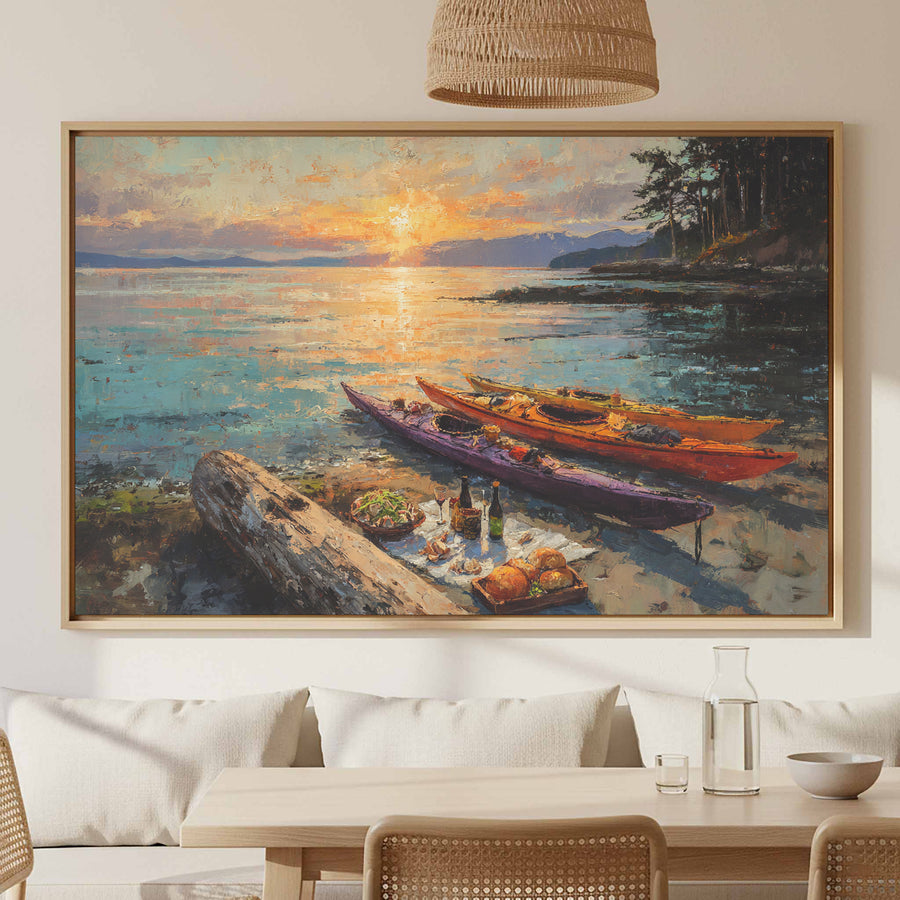
Landscape, Portrait or Square: Choosing Orientation for Your Wall
By: Canvora | October 2026
Most people choose art by subject and only then discover the shape is wrong for the wall. A wide picture on a tall, narrow wall leaves empty space above and below it. A tall picture over a wide sofa leaves the furniture looking stretched out underneath.
Orientation is worth deciding first. Here is how to match landscape, portrait and square to the wall you actually have.

Start with the shape of the wall
Measure the open wall and the furniture below it. If the wall is wider than it is tall, as most walls above sofas, beds and sideboards are, a landscape piece usually fits best. If it is taller than it is wide, a portrait piece does.
Horizontal furniture likes horizontal art. A scene such as The Long View, a mountain landscape, echoes the long line of a sofa or bed. As rules of thumb, a 48 × 32 or 60 × 40 landscape suits a wall above an 84-inch sofa, 36 × 24 or 48 × 32 suits a queen bed, and 36 × 24 or 48 × 32 suits a dining area.
Ceiling height and sight lines matter too. In a room with a high ceiling, a portrait piece or a pair of tall pieces fills vertical space that a single landscape would leave empty. In a room with a low ceiling, landscape keeps the eye moving along the wall instead of up toward the ceiling.

Landscape: wide walls and horizons
Landscape is the natural home of any picture built on a horizon, such as coasts, plains, valleys and skies. Room to Think, a minimalist abstract coastal horizon, is that idea in its simplest form, with a long line of calm across the wall.
Landscape also suits an entry table or console, where 18 × 12 or 24 × 16 are the published sizes. In an office, aim for at least 36 × 24 if you choose a landscape piece.

Portrait: narrow walls and height
Portrait is the answer when the wall is tall and narrow, such as beside a door, between two windows, along a stairwell, or in a room with a high ceiling. It draws the eye up and can make a ceiling feel taller. Carrying the Sky, a celestial silhouette, is offered in portrait sizes that suit this kind of wall.
In an entry or hall, 16 × 24 is the published portrait suggestion. In an office, a 24 × 36 portrait is a good alternative to a 36 × 24 landscape. Above a sofa, a pair of 24 × 36 portraits can stand in for one wide piece.

Square: steady and balanced
Square sits between the other two. It does not pull the eye sideways or upward, which makes it steady. It suits a wall that is about as tall as it is wide, a short stretch between a window and a corner, or a spot above a desk. Barefoot Again, a coastal beach path at sunset, is offered in square sizes.
Not every piece comes in square, so check the product page. It is the authority on which shapes and sizes each piece comes in.

Let the picture choose its shape
The best orientation also matches the image. A long horizon wants width. A single standing subject wants height. Squeezing a picture into the wrong shape wastes the composition, so choose a piece made in the orientation you want rather than trying to turn one.
Portrait pieces such as Left Wild, a blue wildflower abstract, are worth a look if your wall has more height than width to fill.
If you hang more than one piece, keep the orientation consistent within a group unless you have a clear reason to mix. Three landscapes in a row read as calm. A portrait and a landscape side by side can work, but only when their top or bottom edges line up. Planned three-piece gallery walls are an easy place to see how pieces sit together at scale.
Before you buy, tape the outline of the size you are considering on the wall with painter's tape, then step back and look. Each product page also shows every size to scale on a real wall, above an 84-inch sofa beside a 5 ft 8 in figure. The size guide covers every size, and the gallery walls page shows ready-planned groups.
Inspiration


Get Design Tips
New journal posts, room ideas and gallery walls, by email
More from the Journal
-
 Going Big: When One Large Piece Beats Several Small Ones
October 27, 2026
One 48 × 32 or 60 × 40 piece can do more for a wall than a cluster of small ones. How to tell when, and...
-
 Nursery and Kids' Room Art That Grows With Them
October 27, 2026
Soft palettes, storybook animals and secure hanging help a child's room art last from nursery to big-kid bedroom.
-
 Art for Kitchens and Bathrooms: What Suits Them and What to Avoid
October 27, 2026
Steam, splashes and heat are hard on prints. Where to hang art in kitchens and bathrooms, which subjects suit them, and the care limits to respect.