Caring for Canvas and Paper Prints
By: Canvora | October 2026
Wall art needs very little routine maintenance. The important choices happen at placement and handling: keep the surface dry, avoid unstable heat and humidity, and use a gentle method when dust gathers. Canvas and paper are different objects, but neither benefits from household cleaner, wet cloths, or prolonged direct sun.

Place art in a stable indoor setting
Keep artwork indoors and away from sustained direct sunlight, high humidity, and heat. A bright room is not automatically a problem; the concern is a location where strong sun repeatedly falls across the printed surface for long periods. If that describes the wall, use window coverings during the brightest hours or choose a different position.
Avoid hanging art where steam, cooking residue, or a humidifier reaches it. Bathrooms, unfinished basements, and the wall immediately above a working fireplace can change temperature or humidity quickly. Those conditions are harder on paper, canvas, frames, and backing materials than an ordinary living space.
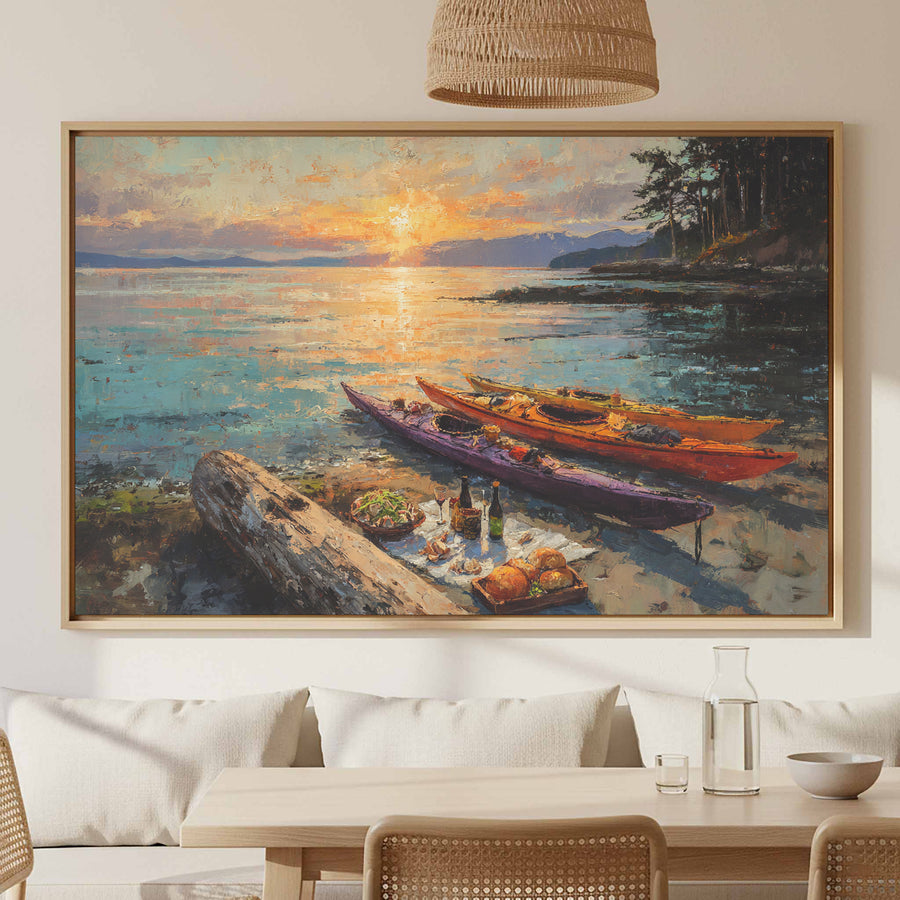
A bright floral work such as Sunflower Bouquet should keep its color relationship without needing the sun itself. Coastal Seascape can bring an open-water feeling to a room without being placed in a damp environment.

Dust canvas and frames gently
Use a clean, dry microfiber cloth. Support the piece securely and pass the cloth lightly across the frame and accessible surface. Do not press into the canvas, scrub a mark, or use a rough duster that can catch an edge.
Do not spray cleaner or water onto the printed surface. Do not apply solvents, furniture polish, glass cleaner, or an all-purpose cleaning product. If a canvas has more than ordinary loose dust or has been exposed to a spill, stop before experimenting with moisture or chemicals.
The same dry approach applies to a framed canvas such as White Tree Silhouette. Dust the outer frame and exposed canvas separately, using a light touch around the inner edge.
Handle paper by the edges
Rolled posters are shipped unframed. Clean, dry hands and a clear work surface help prevent fingerprints, creases, and edge damage. Handle the sheet by its edges and avoid placing objects on the printed area.
Frame paper behind glazing when practical. The frame, glazing, mat, backing, and hanging hardware are chosen separately from the rolled poster. Use archival-quality materials if long-term preservation is a priority, and make sure the finished frame is properly supported by hardware rated for its weight and the wall material.
Do not try to flatten a rolled print with heat, steam, or heavy objects directly on the image. Give the paper time to relax in a clean, dry setting or take it to a professional framer.

Move and store with the surface protected
When moving canvas, lift it by the frame or stretcher structure rather than pressing fingers into the front. Keep hard objects, hooks, and frame corners away from neighboring printed surfaces. A clean sheet of appropriate protective material between pieces can prevent abrasion during a short move.
Store artwork in a stable indoor environment. Avoid attics, garages, and damp basements. Keep pieces upright when their construction allows, protected from crushing, and clearly separated so hanging hardware cannot scratch another work. An image with a strong surface field, such as Abstract Orange, deserves the same simple protection as a detailed scene.
Check the selected product
Materials and construction vary by medium and selected variant. Posters may use fine-art, semi-gloss, or matte paper. Stretched canvas and framed canvas have their own profiles and hardware. Review the product page for the exact configuration you ordered.
Care is mostly restraint: a suitable wall, dry dusting, careful edges, and no improvised cleaning products. Those habits protect both the printed surface and the physical object around it.
Inspiration


Get Design Tips
New journal posts, room ideas and gallery walls, by email
More from the Journal
-
 Going Big: When One Large Piece Beats Several Small Ones
October 27, 2026
One 48 × 32 or 60 × 40 piece can do more for a wall than a cluster of small ones. How to tell when, and...
-
 Landscape, Portrait or Square: Choosing Orientation for Your Wall
October 27, 2026
Wide walls suit landscape, narrow walls suit portrait, and square sits between. How to pick the shape that fits the wall you have.
-
 Nursery and Kids' Room Art That Grows With Them
October 27, 2026
Soft palettes, storybook animals and secure hanging help a child's room art last from nursery to big-kid bedroom.