Choose Wall Art for a Video Call Background
By: Canvora | October 2026
Art behind your desk has two audiences: you and the people who see a small version of the room on a video call. A composition that looks balanced in person may be cropped strangely by a webcam or obscured by your head. Rather than decorating for an imaginary studio, use the camera and chair you already have. Make a private test call or preview, then look at the real frame. The aim is a background you like that also remains clear and comfortable on screen.
Start with the camera crop
Set the laptop or webcam at the position you actually use for work. Sit normally and note the visible wall boundaries. Some cameras show a much wider view than others, and different meeting applications may crop the same image differently. Take a screenshot of the preview and mark the space around your shoulders and head. This reveals whether the art would be fully visible, partly hidden, or repeatedly cut off as you move. Do not rely solely on the room’s straight-on architectural view.
Decide how much personality belongs on screen
A background can be personal without telling everyone your entire story. Choose a subject you are comfortable having visible to colleagues and clients. If documents, addresses, family photographs, or other private details sit nearby, review those separately. Artwork does not need to advertise your profession or match a company color. It can simply be an image you enjoy. The useful distinction is between intentional personality and information you did not mean to share when a camera happens to turn on.
Compare simple and detailed images at screen size
Look at candidates as small thumbnails within your test screenshot, not just as large product photographs. Fine detail may become indistinct on a call, while strong contrast can remain prominent. Neither outcome makes an artwork wrong for the room, but it changes what remote viewers see. If you want a quiet background, choose based on the reduced image rather than the amount of detail you admire up close. Avoid assuming a landscape is always subtle or an abstract work is always bold.
Test the hours you actually work
Check the camera in morning and afternoon light, and under any lamp you use after dark. Windows can change the background’s apparent brightness considerably. Notice distracting reflections without inferring a product’s finish from a photograph. If finish matters, confirm the selected option with the seller. Adjust the desk or lighting when practical before forcing artwork into an unsuitable place. A well-positioned piece should not require you to sit uncomfortably or work with light that makes the screen difficult to see.
Make sure the room still works offline
Turn the camera off and walk into the room. Do you still like the arrangement? If the artwork is purely a background prop that looks awkward from every other angle, reconsider its position. Seasonal decorations can temporarily change the frame, so make a quick private preview after adding them. Before ordering, check the physical size and format of the selected product and test an outline on the wall. The best background is one that belongs to a room you actually want to spend time in.
A starting point to compare
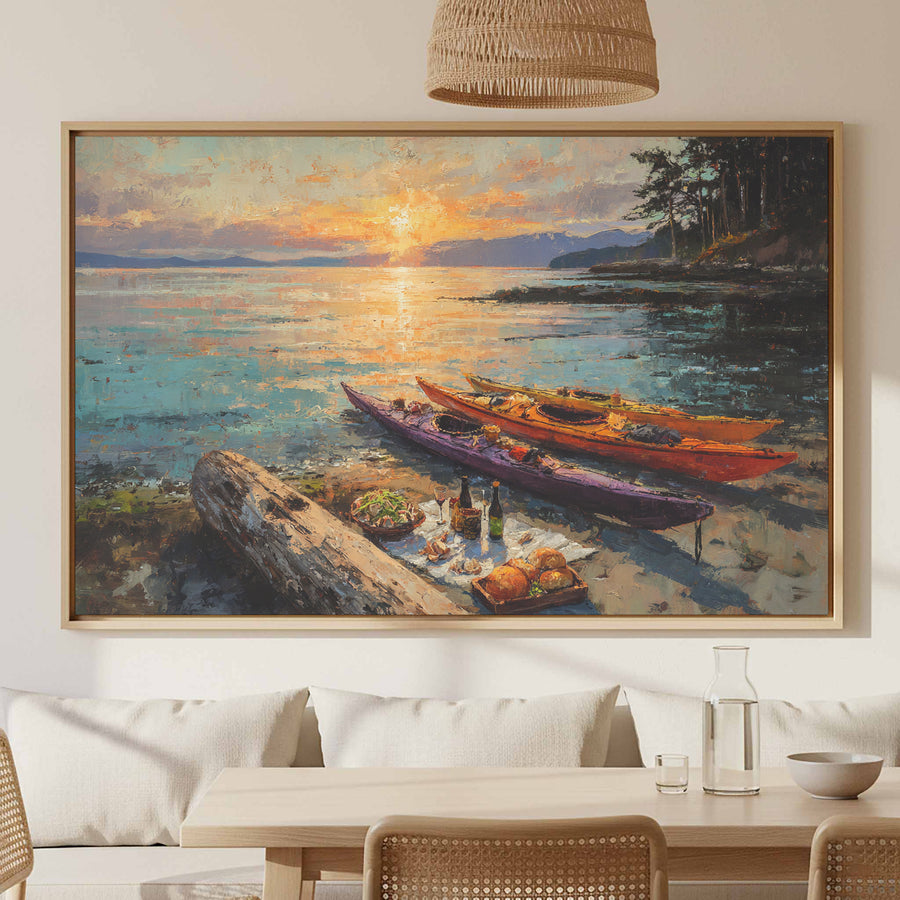
Explore Serene Seaside Landscape Art as one possible direction, then compare the artwork with your own room. Read the selected product options for the physical format, available dimensions, and what is included; a styling example does not establish those details.
Keep planning your room
For a broader palette decision, read How to Choose Wall Art Colors for Your Room.
Get Design Tips
New journal posts, room ideas and gallery walls, by email
More from the Journal
-
 Going Big: When One Large Piece Beats Several Small Ones
October 27, 2026
One 48 × 32 or 60 × 40 piece can do more for a wall than a cluster of small ones. How to tell when, and...
-
 Landscape, Portrait or Square: Choosing Orientation for Your Wall
October 27, 2026
Wide walls suit landscape, narrow walls suit portrait, and square sits between. How to pick the shape that fits the wall you have.
-
 Nursery and Kids' Room Art That Grows With Them
October 27, 2026
Soft palettes, storybook animals and secure hanging help a child's room art last from nursery to big-kid bedroom.